
Most pickleball players start playing pickleball doubles. But it’s also possible to play pickleball singles!
There are lots of reasons why you might want to play pickleball singles over a typical doubles game.
For a start, you don’t need as many people to play! That means it can be easier to play pickleball singles spontaneously – perhaps on your makeshift pickleball court.
Pickleball singles can also be a better way to enjoy pickleball for exercise. If you are planning on playing singles pickleball, you can be prepared for a good workout!
That’s because you will be doing the work for yourself and your partner. Unlike pickleball doubles, where you have a partner to help, you will need to try and be everywhere at once when playing pickleball singles.
Whatever your reason for playing pickleball singles, here is everything you need to know about pickleball singles rules, from scoring to skinny singles pickleball!
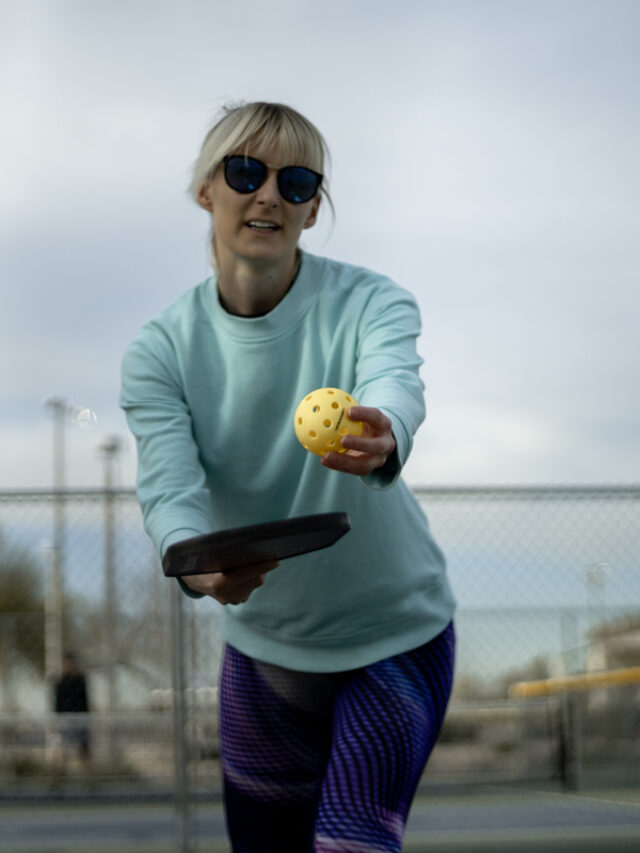

Pickleball Singles Rules
The rules for pickleball singles are the same as playing doubles, but much more will be expected from the player.
Because the player needs to cover the entire court by themselves, it will require a great deal more stamina.
Practicing pickleball drills alone before a game can be a great way to improve your skill and stamina.
How to Play Pickleball Singles
If you’ve played pickleball doubles and are familiar with the pickleball rules, playing pickleball singles is easy!
Many of the pickleball singles rules are the same as the regular pickleball doubles rules:
- One player serves, the other receives.
- Only the person serving can score.
- If the person serving commits a fault, they lose their serve.
- The person serving starts from the right side of their court
Of course, sometimes the game has to play out different because there is only one player on each team.
For example, instead of the two teammates switching sides, a person switches sides when their serve scores a point.
Keep in mind that all of the pickleball serving rules still apply:
- The serve must be done underhand so when the ball is hit, it happens below the server’s naval.
- The serve must be completed with both feet behind the baseline. Neither foot may touch the baseline or the court until after the serve has been done.
- When serving, the ball must be hit into the opponent’s diagonally opposite service area. If the serve contacts any part of the non-volley line it is considered short and is a fault.
- The ball must bounce before the opponent can return it and the return must bounce before the server can return it. This is known as the double-bounce rule. Following hits may be struck before or after the ball has bounced.
- The person serving only gets one attempt, except if the ball hits the top of the net, but still lands in the opponent’s court.
- Players standing in the non-volley zone or on the non-volley line may not hit the ball before it bounces. If the ball contacts any part of the sideline or baseline, it is considered in.
- If the ball is hit into the net or out of bounds, that is considered a fault. If the ball bounces twice before being hit by the receiver, it is a fault for the receiver.
- It is also a fault if a player or any part of their body or clothing touches the net while the ball is in play. Same if the ball hits a player or player’s clothing
- If the ball hits the ceiling, wall, or any other permanent object before landing in the opponent’s court, it is a fault.

Pickleball Singles Scoring
Just like doubles, pickleball games are played to 11 points and the winner needs to win by two points. Points can only be scored by the server.
There is no second serve. The server’s score determines the serving position.
If a fault is committed by the receiver, the server gets a point. The scores are called server score, receiver score.
When the server’s score is even, the server will serve from the right
side of the court. When the server’s score is odd, the server will serve from the left side of the court.
What are Skinny Singles in Pickleball?
Skinny singles in pickleball is a modified version of singles pickleball. It requires less running around as you only use half of the court. You will still have to hit all the balls back yourself, but without running for them.
All the same rules and procedures still apply in skinny singles pickleball. The serve and the play still use the cross-court rule, so you serve to the opposite side of the court and the returns are all sent to the opposite side. If you don’t hit it to the proper side, it is considered a fault.
Popular products from the Pink Pickleball store:
-
 Snug-Fit Polyester Face Mask$5.99
 -
 Snug-Fit Polyester Face Mask$5.99
 -
 Pickleball Slogan Beanie$25.99
 -
 Packable Rain Jacket – Gray$59.99
 -
 Pink Pickleball Logo Sports Bag$26.99
Pickleball Singles Strategy Tips
Everyone has their own strategy but there are a few that should help you win the game faster.
Use The Space
It’s important to try and read where your opponent will go. If they are moving quickly to the front of the net, hit the ball to the back of their court. Try to use their momentum to place yourself at the best advantage to receive the ball.
Keep Near The Back
Try to stay near the back third of the court and close to the centerline. As your opponent moves left or right, do the same, but not too far.
Serve Deep
Sending the ball deep into your opponent’s court makes it more difficult for them to move back forward quickly. This should give you the advantage but just make sure you don’t hit it out of bounds.
Singles Pickleball
If you find yourself without a partner or just fancy a good workout, singles pickleball will test your strengths and get you moving and thinking quickly. Have fun and shoot for the corners.
I tried Pickleball Singles, and Serving is designed to be used as a first strike to get the point, in my opinion. I believe it is appropriate to use a long handle paddle, especially when playing singles, to maximize the scope of where we can do the shot.