
What is a legal serve in pickleball? And how do you tell the difference between legal and illegal pickleball serves?
Welcome back to our pickleball rules series! Today, we’re looking at something that every pickleball player faces at sometime: legal and illegal pickleball serves.
As a new player, learning to serve is one of the most crucial parts of learning to play pickleball. It’s one of the first things that beginner pickleball players learn and it’s something even professional players work on.
Once you’ve found a good pickleball paddle and sorted out your pickleball wardrobe, you’ll probably spend much of your court time working on your serving technique.
The pickleball serving rules are generally quite straightforward in theory, but can be tricky when put into practice. Don’t let that put you off, though – it’s one of the only things you need to wrap your head around!
What makes learning to serve in pickleball even harder is that there’s often a fine line between legal and illegal pickleball serves.
If you’ve been playing pickleball for any length of time, you’ve no doubt had several debates mid-game! When that happens, just make sure you remember the unwritten pickleball etiquette!
So, what is a legal pickleball serve? And – more importantly – what’s an illegal pickleball serve?

This post contains affiliate links, including Amazon Associates links, and we may receive a small commission if you use one. This is at no extra cost to you and allows this site to continue providing free pickleball resources.
Illegal pickleball serves
Pickleball rules are generally quite easy to follow. The one time that pickleball can get confusing – and controversial! – is when it comes to serving rules.
It’s important to make the most of your serve for two reasons, though.
Firstly, you only get one shot at serving. If you commit a fault, you don’t get a second chance to serve.
Secondly – and most importantly – you can only score in pickleball while serving. Therefore, making the most of each serve is crucial!
Here are some things that make a pickleball serve illegal:
Using an overhand stroke.
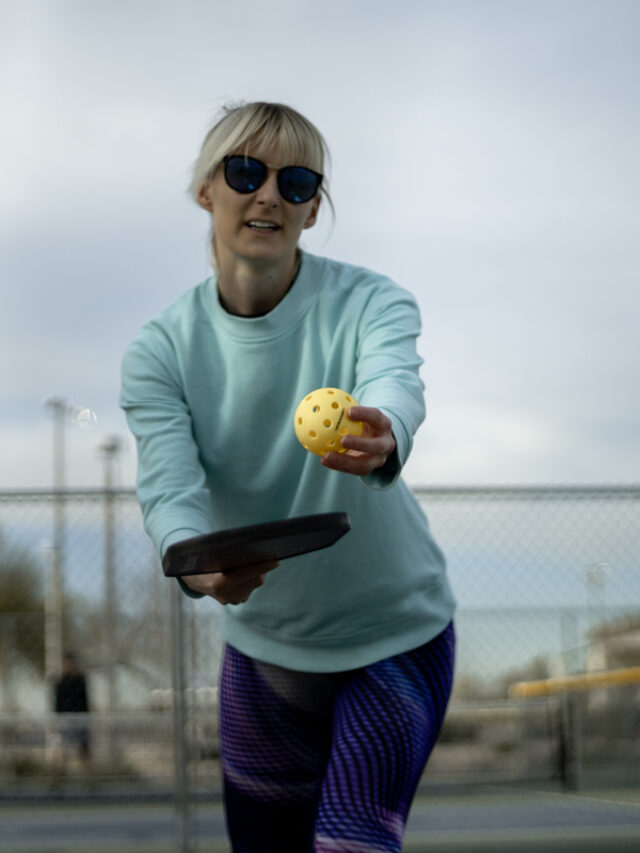
This isn’t tennis – pickleball serves are made with an underhand stroke and upward motion.
This underhand serve creates an upward arc with the pickleball ball.
While it’s completely fine to hit an overhand stroke at any other point during a pickleball game, doing so while serving is considered an illegal serve in pickleball.
Serving above waist level (i.e. navel level).
If the point of contact between the pickleball paddle and the ball is made below waist level, it is considered a legal pickleball serve.
A paddle head above the wrist.
Now, this is where things can get confusing.
When serving in pickleball, only the handle of the pickleball paddle can be above the wrist.
The rest of the pickleball paddle face must be below the wrist.
A serve that takes longer than 10 seconds.
Every pickleball serve begins with a recount of the score, which includes both the serving team’s score and receiving team’s score.
In a game of doubles pickleball, the scoring rules are slightly different to those in pickleball singles because the server also includes the server number.
No matter which type of pickleball you are playing, you have 10 seconds to serve after the score has been called or it’s technically an illegal serve in pickleball.
This is sometimes referred to as the 10-second rule and is one of the pickleball terms you might hear often.
Landing in the kitchen.
When serving in pickleball, the ball must clear both the net and the kitchen – or the non-volley zone, as it’s also called – including the kitchen line.
If the served ball does not clear the non-volley zone line of the opposing team, this is considered a serving fault.
Standing in front of the baseline.
When serving in pickleball, the server’s feet must always be behind the baseline of the service court.
Hitting the ball anywhere but the adjacent service box.
This is one area where the basic rules of pickleball are similar to tennis.
When serving, it is only in if the ball lands in the adjacent service box. Anywhere else is considered out and your serve is over.

How to avoid illegal pickleball serves
We all make errors – it’s part of being human – and you can’t always avoid being guilty of illegal pickleball serves.
However, you can reduce your chances by focusing on serving legally.
Here are some of the best ways to reduce the number of illegal pickleball serves you make on the pickleball court:
1 – Practice makes perfect!
When it comes to perfecting your pickleball serve, nothing beats putting time into it.
If you want to become a better player, it’s essential to make time for pickleball drills.
There are plenty of pickleball drills you can do alone, so there’s no excuse not to get your practice in.
2 – Work on your agility
Getting good at pickleball isn’t all about the time you spend on court. The exercise you do away from the court area is important, too.
Here are six exercises every pickleball player should do. They will improve your agility and control – both of which will help you avoid illegal pickleball serves.
3 – Watch and learn
Perfecting your pickleball serve doesn’t just happen on the court. One of the best ways to improve your serve – and reduce your number of illegal serves – is by watching others.
When you’re watching other pickleball players, especially professional pickleball players, take a look at how they serve.
Observe the motion they use, how they start the serve and where the point of contact is. You’ll probably learn more than you might think!
4 – Brush up on the rules
Even if you’ve been playing pickleball for a while, it doesn’t hurt to brush up on the rules, especially as the International Federation of Pickleball updates the rules of the game regularly.
Even there hasn’t been a rule change, a little bit of reading could spark a thought that helps your technique next time you play.
5 – Practice each type of serve
Before the drop serve was added as a new provisional rule in the 2021 pickleball rule updates, serving meant you hit the pickleball out of the air from your hand.
Since the drop serve became fully integrated into the official rulebook in 2022, you now have the option to drop the ball. Just make sure you don’t let the ball bounce!
It’s good to practice both the standard serve and drop serve so that you can switch between them in a game.

What is a legal serve in pickleball?
What is considered a legal vs illegal pickleball is laid out by the rules of pickleball. However, that doesn’t mean it can’t be a cause of contention on court.
Every pickleball player has a story about a contested serve that ruined the spirit of the game.
Whether they were the server or the opponent, debating what counts as a legal vs illegal serve is something you’re sure to face as some point.
You’re no doubt already familiar with some of these illegal pickleball serves. However, it’s important to be aware of all the rules in pickleball.
This is especially true if you plan to play in tournaments, where pickleball rules are enforced strictly.
Unknowingly playing an illegal serve could even cost you the game!
Is a pickleball spin serve illegal?
If you’ve been playing pickleball for a while, you’ve probably heard somebody claim that a pickleball spin serve is illegal.
As long as you abide by the basic pickleball serving rules, there’s nothing to stop you putting spin on the ball as you serve.
TIP: If you like to put spin on the ball, it might be worth investing in a pickleball paddle that’s good for spin.
Is it illegal to throw the ball in the air before a serve?
Some pickleball players like to throw the ball in the air before serving, as you might do in table tennis.
There are no specific rules saying you can’t do this, and doing so can give you extra time to prepare for your shot.
Is the chainsaw serve legal in pickleball?
The so-called chainsaw serve gained popularity on pickleball courts and at pickleball camps throughout 2021.
The serve, which involved the player rolling the ball against the paddle as the pickleball was being thrown, was banned in 2022.
Therefore it is now an illegal pickleball serve.
Is backhand serve illegal in pickleball?
According to the official tournament handbook of the USA Pickleball Association, a pickleball serve can be made with a forehand or backhand motion.
You can choose whichever you prefer; the important thing is that your serve complies with the other rules. Just keep in mind that it can be much harder to ensure that with a backhand serve.
Can you serve sideways in pickleball?
The pickleball rule book states that the serving motion must be in an upwards direction.
Therefore, serving with an overhead or sideways motion is impossible and against the pickleball rules.
How confident are you in identifying illegal pickleball serves? Have you ever had a dispute on court? Let us know below or join our Facebook community of pickleball players to connect with other picklers and share tips.
See what’s new in the Pink Pickleball store:
-
 Snug-Fit Polyester Face Mask$5.99
 -
 Snug-Fit Polyester Face Mask$5.99
 -
 Pickleball Slogan Beanie$25.99
 -
 Men’s Pickleball Tank Top$27.99
I truly appreciate this article. Thanks Again. Keep writing.
Thanks for all your efforts that you have put in this. very interesting info. Nanni
actually enjoyed what that you published . it really is not that simple to find great posts to read (you know.. READ and not simply going through it like some uniterested and flesh eating zombie before moving on), so cheers man for not wasting my time on the god forsaken internet. :p
Hi
It looks like rules on serving are contradicting above:
In the section. Illegal Serves -serving above the waist it says contact “ below “ the waist is illegal, however under the picture of the lady its says you must contact the ball below the waist. Can you please clarify. I think the top section should say “above” Thanks for the info. As new player easy to understand
I’m confused or there is an error in what’s a legal or illegal serve. In your article there is one section that states it’s illegal to serve below your waist. You might need to proof read better or I’m a knucklehead.
You are correct on both: there was a typo and therefore we need to proofread better. Unfortunately things do slip through the net sometimes! The error was kindly pointed out by another reader and has been fixed.
It is written here, “If the point of contact is made below waist level, it is an illegal serve.”
Are you sure that is what you meant? Should not illegal be replaced with legal?
Good spot! Thanks Brian.
Who decides whether a pickleball serve is legal or illegal?
Thank you for your advice. As a beginner, I’m still practicing the traditional serve.
What’s the ruling for someone standing behind the service line right at the center line, then they reach forward so that they ( the ball and their paddle) would be past the center line when they serve? They remain behind the service line but the ball and paddle extend past the center line which makes it seem like they are serving from the “wrong” side of the court.
I can’t find a rule specifically addressing this.
Any help would be appreciated.